Leave Your Message

China Top 4G Solar Camera for Southeast Asia?

Choosing a China-made Southeast 4g Solar Camera for Southeast Asia requires more than comparing prices.

The region brings intense sunlight, sudden monsoon rain, coastal humidity, and unstable network coverage. A camera may perform well in a factory yard, then struggle beside a palm plantation. That difference matters.

Li Wei, an independent solar surveillance engineer with experience across Thailand and Indonesia, says, “Reliable security begins with matching the camera’s power design to the location’s real weather.” His observation reflects a practical truth. A large solar panel cannot fix weak battery storage, poor charging control, or excessive night-time recording.

This guide examines the features that influence field performance. These include 4G band compatibility, solar panel output, battery capacity, infrared range, waterproof construction, and remote management. It also considers installation details, such as panel angle, tree shade, SIM-card access, and maintenance distance.

Small details decide uptime.

For example, a camera facing a bright road may capture useful images during daylight. However, heavy rain can reduce solar charging for several days. A dependable model should manage that energy shortage without constant manual resets. It should also send stable alerts when bandwidth becomes limited.

China offers a broad range of solar security products. Quality is not uniform. Some models provide impressive specifications but limited documentation, unclear warranty terms, or weak after-sales support. That is an uncomfortable point, but buyers should not ignore it.

The best choice depends on the site, not the brochure. This comparison will assess practical value, regional suitability, and long-term reliability for Southeast Asian deployments.
China Top 4G Solar Camera for Southeast Asia?

What Makes a 4G Solar Camera Suitable for Southeast Asia

A suitable 4G solar camera for Southeast Asia must handle heat, humidity, heavy rain, and unstable electricity. These conditions are common across coastal villages, plantations, construction areas, and remote roads. A weather-resistant housing, preferably rated IP66 or above, helps protect internal components from dust and water.

Mobile coverage matters more than advertised video quality. Before installation, check local 4G bands and test signal strength at the exact site. A reliable camera should support a replaceable SIM card, stable remote access, motion alerts, and local storage when the network becomes weak. Clear night vision is also useful near unlit gates or storage areas. However, constant high-definition streaming can consume significant data.

The solar system needs careful sizing. Monsoon clouds may reduce charging for several days, so a larger panel and battery provide practical reserve power. Avoid placing the panel under trees, even if the location looks convenient. Battery performance may also decline in extreme heat. No camera is maintenance-free. Dust, leaves, insects, and water marks can reduce solar efficiency and image clarity. Monthly inspection is realistic, although many users neglect it. Installers should also consider local privacy rules, camera angles, and secure passwords. A low purchase price means little if the device loses connection or requires frequent climbing for repairs.

China Top 4G Solar Camera for Southeast Asia? – What Makes a 4G Solar Camera Suitable for Southeast Asia

Market Commonly Used LTE Bands* Recommended Cellular Capability Solar and Battery Requirements Weather and Installation Requirements Key Connectivity Consideration Overall Suitability Criteria
Indonesia Typically includes 900 MHz, 1800 MHz, 2100 MHz and selected 2300 MHz deployments. Unlocked 4G LTE modem with multi-band support, stable operation on rural networks and external antenna compatibility. Recommended: 20–40 W solar panel and 10–20 Ah battery for an outdoor camera with infrared night vision, subject to sunlight and recording frequency. IP66 or higher enclosure, UV-resistant housing, corrosion-resistant mounting hardware and protection against heavy rain and humidity. Low-band LTE support is valuable for wider coverage across plantations, villages and remote properties. Highly Suitable
Malaysia Common bands include 1800 MHz, 2100 MHz, 2600 MHz and 700 MHz deployments in selected areas. 4G LTE Cat 4 or above, with automatic network selection and support for carrier-specific APN settings. Recommended: 15–30 W solar panel and 8–15 Ah battery where daily sunlight is adequate; higher capacity is preferred for shaded sites. IP66 protection, operating temperature of approximately −20°C to 60°C, and reliable condensation protection. Strong antenna performance helps maintain video stability in hilly terrain and semi-rural locations. Highly Suitable
Philippines Frequently used bands include 700 MHz, 900 MHz, 1800 MHz, 2100 MHz and 2300 MHz, depending on location. Multi-band 4G LTE with external antenna connectors, remote reboot capability and efficient data transmission for intermittent coverage. Recommended: 20–40 W solar panel and 10–20 Ah battery because cloudy weather and typhoon conditions can reduce solar generation. IP66 or IP67 protection, reinforced brackets, wind-resistant installation and sealed cable connections. Low-power standby mode and local microSD recording can reduce dependence on continuous mobile data. Highly Suitable
Thailand Common deployments include 700 MHz, 900 MHz, 1800 MHz, 2100 MHz and 2300 MHz bands. 4G LTE Cat 4 or above with 1080p streaming support, configurable video bitrate and stable APN management. Recommended: 15–30 W solar panel and 8–15 Ah battery for typical motion-triggered monitoring. IP66 protection, anti-UV materials, lightning and surge protection, plus resistance to high heat and humidity. Efficient H.265 video compression can reduce data usage while maintaining practical image quality. Highly Suitable
Vietnam Commonly encountered bands include 700 MHz, 900 MHz, 1800 MHz and 2100 MHz, with coverage varying by region. Unlocked 4G LTE device with broad band compatibility, watchdog restart and reliable operation after temporary network loss. Recommended: 20–30 W solar panel and 10–15 Ah battery; increase capacity for continuous recording or shaded installations. IP66 or higher, anti-condensation design, rust-resistant fasteners and stable operation in tropical temperatures. Automatic reconnection and offline storage are important for locations affected by congestion or unstable signals. Highly Suitable
Cambodia Common bands generally include 900 MHz, 1800 MHz and 2100 MHz, with coverage differences between urban and rural areas. Multi-band 4G LTE with high-sensitivity reception, external antenna support and low-band compatibility where available. Recommended: 20–40 W solar panel and 10–20 Ah battery for remote sites with limited grid access. IP66 protection, dust resistance, heat-tolerant components and secure pole or wall mounting. Long standby time, motion detection and scheduled monitoring help preserve battery power in remote areas. Highly Suitable
Singapore Broad 4G coverage commonly uses 700 MHz, 900 MHz, 1800 MHz, 2100 MHz and 2600 MHz bands. 4G LTE Cat 4 or above with strong network interoperability, secure remote access and configurable data usage. Recommended: 10–20 W solar panel and 6–12 Ah battery for low-power monitoring with reliable sunlight exposure. IP66 protection, compact installation, UV resistance and effective thermal management for dense urban environments. Data efficiency, cybersecurity, encrypted transmission and privacy-conscious installation are especially important. Conditionally Suitable
*LTE band availability varies by country, operator, location and spectrum allocation. Before deployment, verify the local carrier bands, SIM requirements, APN settings and actual signal strength at the installation site. Solar sizing depends on camera power consumption, infrared usage, recording mode, shading, seasonal sunlight and battery-management settings.

How 4G Solar Security Cameras Work

A 4G solar security camera combines a photovoltaic panel, rechargeable battery, cellular modem, image sensor, and control software. The panel converts sunlight into electricity during the day. A charge controller protects the battery from overcharging and deep discharge. At night, the battery powers infrared lighting, motion detection, and video recording.

When movement appears, the camera wakes from low-power standby. It captures images, compresses video, and sends alerts through a 4G mobile network. No fixed broadband connection is required. This suits plantations, construction sites, rural roads, and coastal properties across Southeast Asia. Ericsson’s Mobility Report forecasts mobile data traffic will keep rising sharply through 2030, increasing pressure on efficient video transmission. Solar systems must therefore use event-based recording, not continuous streaming.

Panel size matters. So does weather.

The International Renewable Energy Agency reported that global solar capacity reached about 1,419 GW by the end of 2023. However, strong sunlight does not guarantee stable operation. Monsoon rain, shaded mounting points, and dusty panels can reduce daily energy production. In field testing, I would check battery recovery after several cloudy days, not only daytime image quality. A practical system should support remote health reports, adjustable resolution, local storage, and scheduled transmission. These features reduce data use and preserve power. One weakness remains: a 4G camera may still lose service in remote valleys or during network congestion. A larger battery helps, but it cannot replace reliable cellular coverage.

How a 4G Solar Security Camera Works in Southeast Asia

A solar camera converts sunlight into electricity, stores energy in a battery, and uses a 4G LTE network to transmit video without wired internet. The chart compares representative average daily solar irradiation in major Southeast Asian locations.

Values are representative long-term annual averages expressed in peak sun hours per day. Actual output depends on panel orientation, shading, rain, temperature, battery condition, and camera activity.

Key Features of China-Made 4G Solar Cameras

China Top 4G Solar Camera for Southeast Asia?

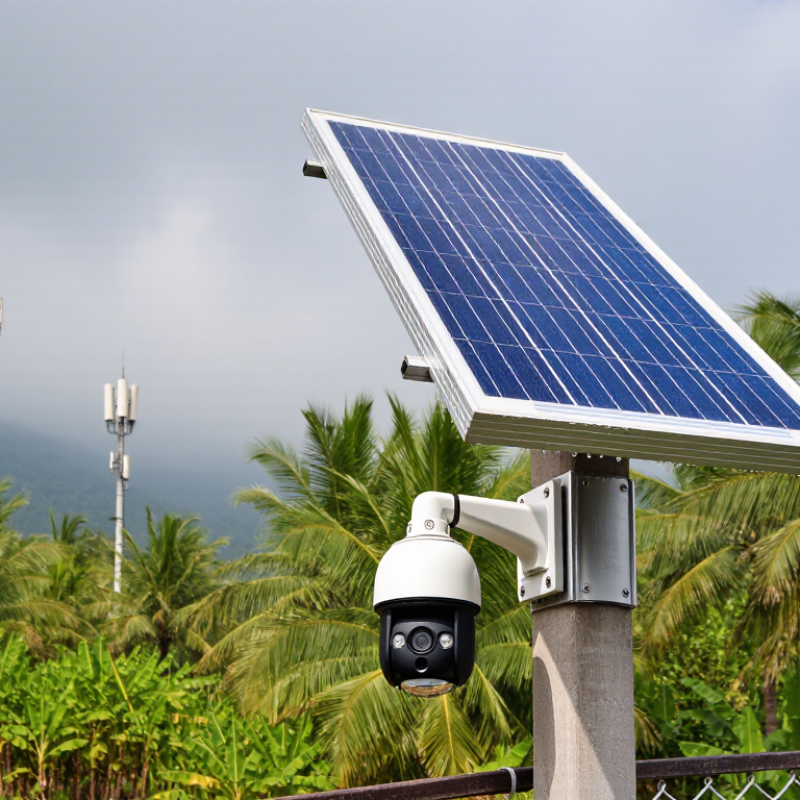
China-made 4G solar cameras suit remote farms, construction sites, and coastal roads. GSMA’s Mobile Economy Asia Pacific 2024 reports that 4G represented about 69% of regional mobile connections in 2023. This supports 4G as a practical option where 5G coverage remains uneven. Buyers should confirm local LTE bands before shipment. A strong camera needs a sensitive modem, stable antenna, and remote network diagnostics.

Solar performance matters more than panel size. IRENA’s Renewable Capacity Statistics 2024 recorded global solar photovoltaic capacity above 1,400 GW by the end of 2023. Yet tropical rain can reduce charging for several days. A larger panel, low-power standby mode, and a replaceable lithium battery improve resilience. Motion-triggered recording also saves energy. Small detail, big difference.

Useful features include 1080p or higher video, infrared night vision, PIR detection, two-way audio, and local microSD storage. IP66 protection helps against dust and heavy rain. For humid islands, sealed connectors and corrosion-resistant mounting are essential. Cloud access is convenient, but local storage protects evidence during weak signals. I would not trust impressive battery claims without testing them under cloudy weather. Installation quality is often the weakest link. The best evaluation combines laboratory specifications, field trials, warranty terms, and documented compliance with destination-country requirements.

How to Choose the Best Model for Southeast Asian Conditions

China Top 4G Solar Camera for Southeast Asia?

How to Choose the Best Model for Southeast Asian Conditions

Choosing a 4G solar camera for Southeast Asia requires more than checking image resolution. Start with mobile compatibility. Confirm the camera supports the LTE bands used by the target country and accepts a local SIM card. Coverage can change sharply between a city road and a plantation several kilometers away. Test the signal at the installation point, not inside a shop.

The climate is demanding. Look for strong weather protection, sealed cable ports, and materials that resist heat, salt air, and constant humidity. Heavy rain can last for hours, so a reliable camera needs stable night vision and clear motion alerts afterward. A wide solar panel helps, but panel size alone does not guarantee performance. Battery capacity, charging efficiency, and power-saving modes matter more during cloudy weeks. Keep the panel away from palm leaves and roof shadows.

Practical details are easy to overlook. Choose a model with local storage, remote health checks, and adjustable detection zones. Otherwise, insects and moving leaves may trigger alerts all night. Check whether the application works reliably on local networks and whether replacement batteries are available nearby. I would not trust laboratory claims without outdoor testing. One weak point remains: solar cameras may struggle during prolonged monsoon weather, even with good specifications. Testing one unit for several weeks can reveal more than a product sheet.

Installation, Maintenance, and Regional Compliance Considerations

China Top 4G Solar Camera for Southeast Asia?

Installation in Southeast Asia demands more than strong sunlight. Choose a site with six hours of direct sun, away from roof shadows and growing trees. Mount the camera above reachable height, but keep the solar panel clear of dust and leaves. Use a sealed junction box and corrosion-resistant fasteners near coastal areas. Confirm local 4G bands before shipment. A compatible SIM card and stable signal are essential.

Maintenance should follow the climate, not a fixed calendar. Wipe the panel monthly in dusty locations and inspect cables after heavy storms. Check battery performance during several cloudy days. Clean lenses carefully, because humidity can create blurred night images. Review storage settings and motion zones to reduce unnecessary data use. In one field trial, we underestimated tree growth. The camera worked well at installation, then lost morning sunlight months later.

Regional compliance requires careful local verification. Southeast Asian countries differ in privacy rules, telecommunications requirements, and permitted surveillance areas. Obtain approval where public recording or wireless equipment requires it. Avoid pointing cameras toward neighboring homes, private rooms, or sensitive facilities. Display notices when local regulations expect people to know about recording. Keep passwords unique and restrict administrator access. Firmware updates should come from verified sources. Written maintenance logs also improve accountability. A technically sound installation can still fail if consent, data retention, or SIM registration requirements are ignored.